Practical shopping guide
Secondhand Model Kits in Japan: Check What Is Inside
A resale kit can be unbuilt, partly built or missing parts. Separate the condition of the box from the condition and completeness of the model you want to make.
By SprueVia Japan · Updated
Research transparency: source checks and firsthand visits are kept separate. Editorial standards · Research log · Disclosure.
Jump to a section
Understand the condition words
On a small screen, swipe across the table to compare all columns.
| Label | Meaning | What it does not establish |
|---|---|---|
| 未組立 / mikumitate | Unassembled | That every runner, decal and extra is present. |
| 内袋未開封 / uchibukuro mikaifū | Inner bags unopened | That the outer box is unopened or undamaged. |
| 開封済み / kaifūzumi | Opened | Whether assembly has begun; ask what was opened. |
| ランナー / rannā | Runner / sprue frame | That every part remains attached. |
| 欠品 / keppin | Missing item or part | Which part; read the detailed note. |
| 箱傷み / hako itami | Box wear or damage | Whether the model contents are affected. |
| 組立済み / kumitatezumi | Already assembled | That it can be disassembled without damage. |
The translations are reading aids. Ask the shop to explain its complete condition statement. For an example of separate descriptions, this Mandarake historical auction listing records box condition and unassembled, inner-bag condition separately. It is an example of terminology, not a currently available recommendation.
See one complete Japanese condition note decoded to distinguish unassembled, opened bags, loose parts and box wear in the same listing.
Inspect in a useful order
- Confirm the edition: compare name, scale, grade, version and any limited coating or colour description. A near match is not an exact match.
- Ask permission to inspect: let staff decide whether and how the outer box can be opened. Do not break sealed bags to investigate.
- Match the parts list: compare runner letters and quantities with the correct instructions. Separate loose parts, clear pieces and small bags can be easy to overlook.
- Check consumables and extras: ask about decals, stickers, cables, display bases and special bonus items. Different editions can include different extras.
- Read the defect note: ask whether runners are cut, glue or paint was applied, parts are missing or the seller has not checked completeness.
- Record the agreement: retain the condition description and receipt. Confirm what happens if an undisclosed missing part is found later.
Bandai’s official instruction database can help locate a parts list for supported products. It is not proof of the contents of the box you are holding. When the exact manual is unavailable, ask the seller how completeness was checked.
Decide which defects you can accept
On a small screen, swipe across the table to compare all columns.
| Finding | Builder’s question | Collector’s question |
|---|---|---|
| Outer-box scuff, contents verified | Does the saving justify cosmetic damage I do not mind? | Is the packaging still acceptable for my collection? |
| Missing decal sheet | Can I finish the model as intended without it? | Is an incomplete original set acceptable? |
| Cut runners or loose parts | Can completeness be checked before purchase? | Does this meet my desired condition? |
| Unknown missing parts or partly glued model | Am I deliberately buying a repair or spare-parts project? | Can this ever meet the condition I want? |
Our default for a first-time builder is a complete, understandable kit. Do not assume a manufacturer will replace missing parts for an overseas buyer or that replacement will arrive before your flight. Verify the applicable parts service before relying on it.
Compare with a complete alternative
Write down the asking price, missing items, required replacements and the effort you are prepared to spend. Compare with the total price of a complete version you would actually buy. A cheaper incomplete kit is not automatically better value.
Hypothetical example: a ¥3,000 kit with an essential missing runner is not a ¥1,000 saving against a complete ¥4,000 kit unless a suitable replacement is available and its total cost is known. If that cost cannot be established, keep it as an unresolved requirement rather than entering zero in the calculator.
Keep the kit and its evidence together
Protect the box corners and keep instructions, decals and small extras together. If you rearrange luggage, label the parts by kit so similar runners do not get mixed. Do not throw away packaging or return documents before you have checked the purchase against the stated condition.
Choose a stop from our hobby-store guide based on your itinerary. The guide describes stores’ published categories, not which secondhand kit is available today.
Four boxes, four different decisions
Illustrative situations, not reports of a particular shop or live offers.
Scuffed box, verified contents
The lid is dented, but staff can account for the runners, instructions and decals.
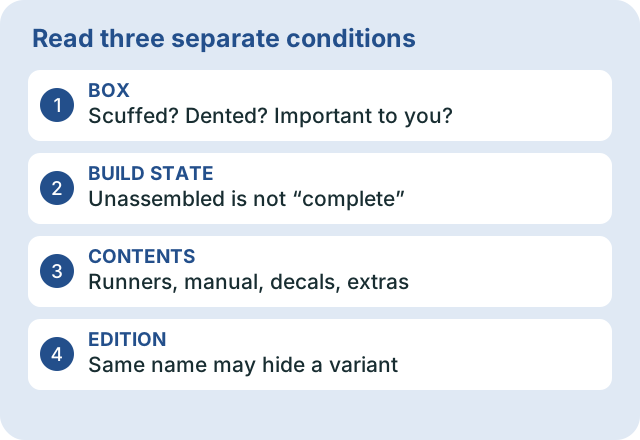
A builder may accept cosmetic packaging damage; a box collector may not. Separate your packaging preference from missing model parts before comparing the price.
Unassembled, but a runner is missing
The label says unassembled. The detailed note names a missing runner.
Unassembled describes build state, not completeness. Identify whether the missing runner is essential to your planned build; do not assume a replacement can be ordered overseas.
Special edition, ordinary instructions
The name resembles the standard release and the manual looks familiar.
Match the product code and edition. Check the pieces, finish, decals and extras that distinguish the release. A similar instruction booklet does not settle the edition.
Partly built bargain
Some parts are cut from runners and a section is already glued.
Treat this as a deliberate repair or spare-parts project. A first-time builder wanting a complete build should compare with a complete alternative instead.
Official pages linked in this guide were checked September 24, 2026. Selection advice, examples and checklists are our editorial guidance. We have not visited or tested these stores or products. Recheck hours, entry rules and item availability before travelling. Our source policy.